You've spent six editions recognizing a problem that most legal departments live with but can't name. Invisible time. Silent leaks. Structural rework. Meetings that could be emails. Legal software that solves the vertical problem but doesn't touch the horizontal one.
Now comes the turning point of the series. The next four editions shift from diagnosis to proposition. This first edition of the Solution phase introduces — for the first time directly — a category of software that is emerging in the U.S. and that legal doesn't yet have consistent vocabulary to describe. It goes by several names: legal workspace, unified legal platform, legal collaboration layer.
There's also a structural change in the series: starting with this edition, ENSPACE appears by name when relevant. Not as the exclusive protagonist of the category — there are other options in the global market, and the reader deserves to know them. But as the option most aligned with the concept this edition presents.
You don't need another legal software tool. You need something your legal software was never built to be.
Every specialized tool does two things simultaneously. First, it solves a well-defined problem with depth — matter management, CLM, e-billing. Second, it creates a boundary: everything inside its scope, it handles; everything outside, is someone else's. That boundary is both virtue and limitation.
The virtue is focus. Good legal software is good precisely because it knows the vertical problem it attacks. Domain-specific vocabulary, workflows, rules. Trying to make one system that does everything — matter management, contracts, research, internal communication, intake, knowledge management — produces mediocre software in every dimension.
The limitation is the exact reverse. Real legal work doesn't respect tool boundaries. A request arrives via Slack. Becomes research involving three precedents. Results in a draft requiring senior review. Gets communicated by email to the business unit. Comes back with a question that needs a formal memo. Gets filed — somewhere. It crossed five different tool categories, and at least four of them don't talk to each other.
A legal productivity layer is a software that has five simultaneous characteristics:
It doesn't replace the matter management system, the CLM, or the research tool. It connects to them or coexists with them, capturing the work that happens between them.
Instead of forcing the user to decide 'is this a matter? a contract? an opinion?' before logging it, it captures the raw context first and structures later. Reflecting how work actually arrives at legal.
It shows where time is going: how much is spent on each type of task, who's waiting for what, where the queues are, where the delays are.
It replaces some meetings and emails with structured written communication, with preserved context, registered decisions, and async access for everyone involved.
Instead of requiring the team to document decisions in a separate wiki, it naturally captures decisions and rationale in the flow of work.
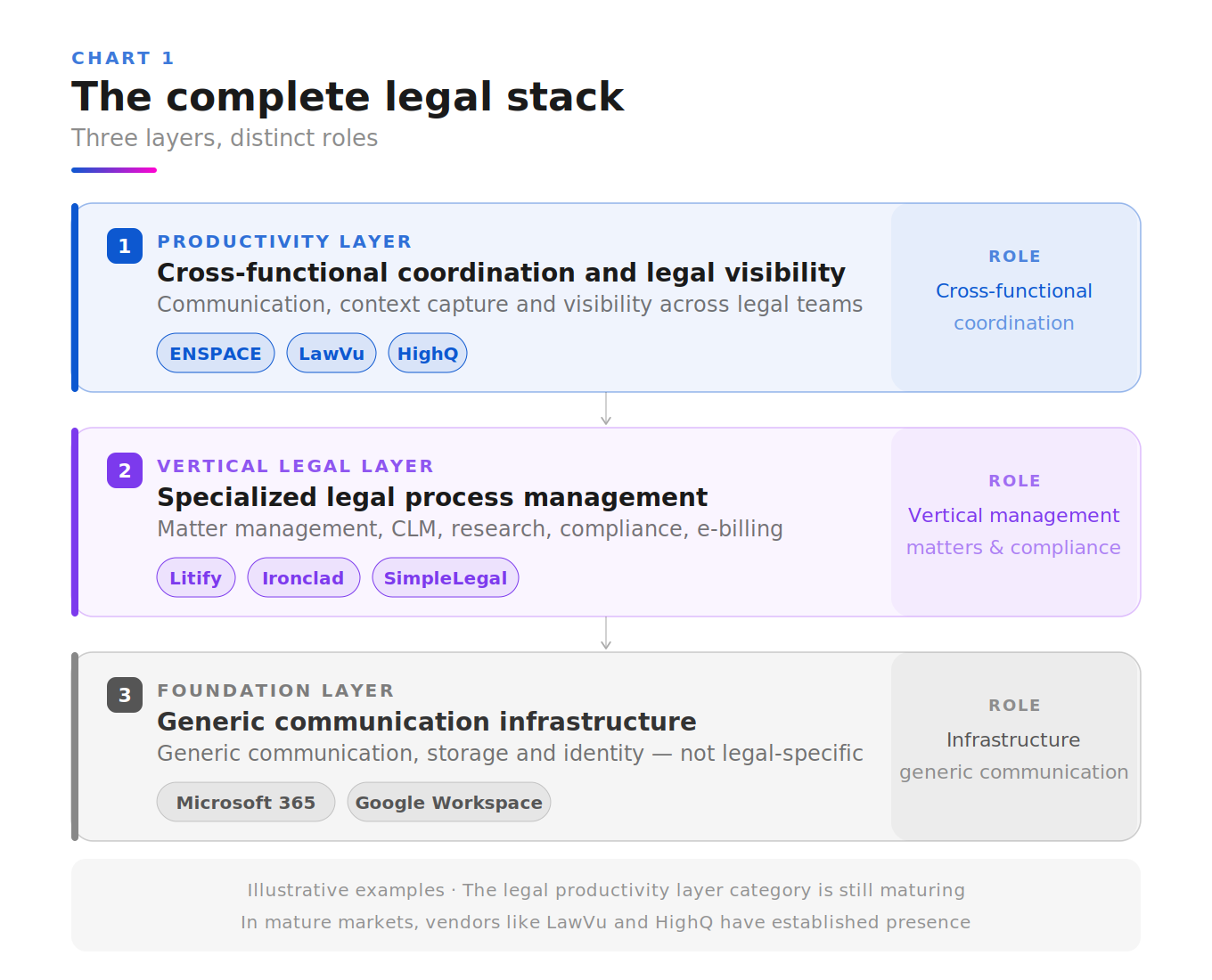
The most common objection is understandable: we already have too many systems. The right question, though, isn't another system? — it's does this replace or complement?
A well-designed productivity layer complements without multiplying work. Ideally, it connects to existing vertical tools via integration: a matter's status in the matter management system appears inside the layer; a decision made in the layer pushes the corresponding update to the CLM; a request logged in the layer automatically becomes an item in the right system.
The practical criterion is clear: if adopting the layer makes anyone type the same thing in two places, it's misconfigured. A productivity layer isn't another field to fill. It's an environment where cross-functional work happens and where what already exists in the verticals is accessible.
Gartner projected in 2024 that by 2026, 40% of legal departments will have implemented workflow technology for systematic intake and triage. 64% of legal leaders plan to accelerate technology investment in the next two years. The global Legal AI market jumped from $1.5 billion in 2024 to over $3 billion in 2025.
But behind the aggregate numbers is an uneven reality. In the most mature U.S. legal departments — Fortune 500, large tech companies — productivity layers are already becoming standard. In mid-market legal departments, adoption is still the exception.
That lag is, paradoxically, an opportunity. Legal departments that adopt a productivity layer in the next twelve to eighteen months will have real competitive advantage over peers still operating in the fragmented default. Not because of the tool itself — but because of the operational transformation it enables: time visibility, rework reduction, structured communication, knowledge capture. Everything the last six editions showed costs real money.
Before adopting any layer — ENSPACE or any other — every legal department needs to complete an exercise that many skip. Deciding, with clarity, what to automate, what to delegate, what to centralize, and what to simply eliminate. Without this exercise, automation only accelerates chaos. The next edition brings a practical framework for that decision — in a matrix format you can apply in a 90-minute meeting with your team.