The business case for the modern legal department
You know your legal department needs to change. Your team knows. But the person who approves budget doesn't live the pain. And that's where the problem lies.
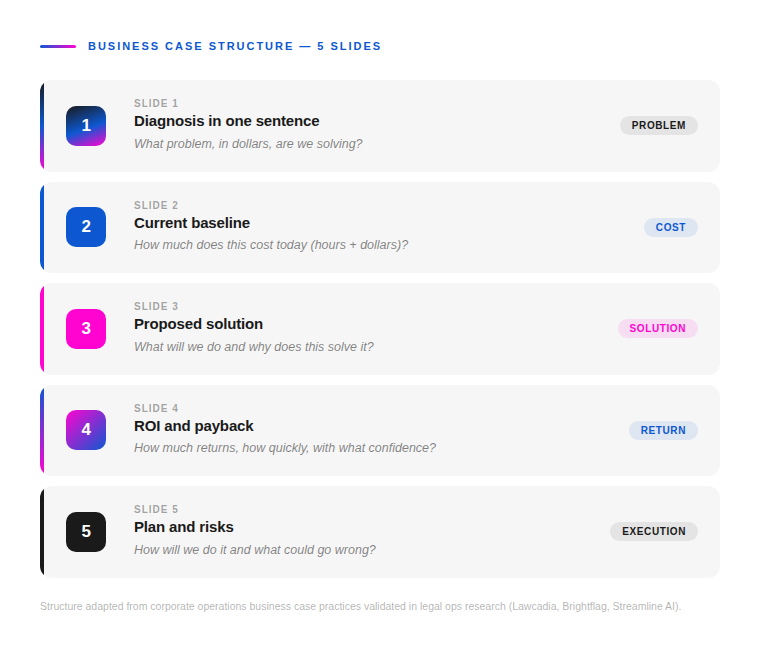
Most legal transformation projects die in the leadership presentation. Not because the idea is bad. Not because the ROI is insufficient. Because the presentation is made in the wrong language — the language of legal to legal, instead of the language of legal to finance.
Legal operations managers typically present the problem with operational vocabulary: we're overwhelmed, there's too much rework, we lack visibility. All true. None of it resonates with a CFO. A CFO doesn't approve a solution for a symptom — they approve a solution for a measurable problem denominated in dollars.
CFOs don't approve productivity. They approve measurable return, risk mitigation, or talent retention. Present one of those three, and you're in the conversation. Present abstraction, and you're in the queue.
There's a simple reason CFOs view productivity pitches with suspicion. Productivity is a word used everywhere, usually without operational definition, and almost always without defensible metrics. In tight budget environments, any vague request competes with concrete ones — and loses.
The vocabulary that opens doors is financial, not operational. It has three pillars, and any solid business case needs to address at least two:
How much does the company spend today, in dollars, on something it will spend less on afterward? This includes reduction in outside counsel spend, reduction in attorney hours on operational tasks, reduction in related administrative costs.
What's the average cost of a legal problem this project reduces the probability of? This includes fines avoided through more robust compliance, lawsuits reduced through better contract review, losses avoided through better deadline management.
How much does it cost to replace a mid-level or senior attorney, and what's the reduction in departure probability this project generates? This pillar is the most underused and — in departments with qualified professionals — often the most powerful.
The minimum structure of a defensible ROI calculation has four components:
How much is spent today, in hours and dollars, on the activity that will be impacted? Not a soft estimate — a number that can be audited. If the department spends roughly 12 hours per week on manual status updates for business units, multiply by the average fully-loaded hourly cost of whoever does it, by 50 weeks.
How much will this problem realistically decrease? Published studies on legal technology adoption show typical ranges: 50-80% reduction in information search time, 30-50% in manual status updates, 20-40% in context rework. Use the range, not a single number.
Not just the annual license. Include implementation, training, team time during adoption, integration with existing systems, recurring costs. CFOs notice when adoption time isn't calculated.
Research with legal departments that adopted productivity layers suggests typical ROIs between 200% and 400% within 12-18 months, with average payback around 6-9 months for successful implementations.
There's an underused tactic: framing the project as risk reduction, not productivity increase. Productivity is a future benefit with imperfect measurement. Risk is loss avoidance, measurable by probability times impact, with a different budget logic.
The Axiom 2024 survey found that 89% of in-house counsel reported dissatisfaction, with excessive administrative tasks cited as a key driver. Over 55% of mid-level attorneys were actively seeking or open to new positions. Replacing a mid-level to senior attorney costs, on average, six to twelve months of annual salary including recruiting, training, productivity loss, and integration.
The sentence that usually turns the conversation is simple: if this project reduces senior attorney departures by even one per year, it pays for itself — before any productivity gain or risk reduction.
The structure that wins is phased:
This model transforms one large decision into three small ones. Each phase is evaluated on data from the prior one. The Axiom 2025 report indicated that 61% of GCs expected budget growth — and most of it was allocated to phased projects, not one-time transformations.
The next is the final edition of the series. After nine editions naming the problem, mapping its patterns, and presenting the path to solution, we close with the vision. The high-performance legal department in 2027: what five capabilities will separate modern departments from slow ones, and how to start building those capabilities today. It will also be a final invitation — for those who've made it this far and want to take the next concrete step.