CLOC's (Corporate Legal Operations Consortium) Core 12 model organizes the field of Legal Operations into 12 core competencies, ranging from Data Intelligence and Financial Management to Legal Technology and Strategic Planning. Applied in Brazil, the model needs to be adapted to local realities like the country's data privacy law and its high litigation volume.
Corporate legal has gone through a significant shift over the past two decades. From a function focused almost entirely on risk management, the field evolved to take on a more strategic lens and, more recently, stepped into the role of a business partner within the company, with a real voice in decisions that used to sit strictly with finance and operations. That shift has demanded a more cross-functional style of management, one that brings controllership, technology, and legal operations together within the legal department itself.
Legal Ops has become the function responsible for tying these threads together within legal departments, giving that shift the structure needed to succeed. Understanding the fundamentals of this transition, and its strategic role inside the business, is what separates a department that only reacts to requests from one that already operates as a true business partner.
To standardize these practices across the global corporate market, the Corporate Legal Operations Consortium (CLOC) built a maturity model known as the Core 12, a set of 12 competencies designed to streamline workflows and professionalize legal management. Applying this global model in Brazil requires sound strategic judgment, balancing the standards of a mature market like the US with the operational realities on the ground locally. Just as important, it takes knowing how to translate each competency into a business case, because that's how General Counsel can build a compelling business case for additional investment.
For executive decision-makers, General Counsel and CFOs alike, building out a Legal Ops function shouldn't be treated as an added cost. It's a strategy for making better use of existing headcount.
Data compiled by HBR Consulting helps put a number behind that business case:
The technical time drain. In-house attorneys spend an average of 6% of their time on administrative and operational tasks, while other department staff spend 7.6% of their working hours on the same kind of work.
The potential savings. In a mid-to-large legal department (roughly 30 attorneys and 26 support staff), shifting purely administrative work to qualified Legal Ops professionals delivers an estimated $530,000 in annual savings on compensation costs.
It's worth noting that this data comes from US research, based on payroll costs at American legal departments. It's a useful reference point for a real, proven gain in a market where Legal Ops has already reached maturity.
Historically, the US market built out Legal Ops almost entirely around aggressively cutting outside counsel spend. As the field matured, the focus shifted toward building agile solutions and driving continuous process improvement.
In Brazil, the shift toward efficiency is even more complex. Given the sheer volume of active litigation and constantly changing tax regulations, a Legal Ops professional in Brazil carries responsibility that goes well beyond rolling out technology. They're also managing operational risk in a high-litigation environment.
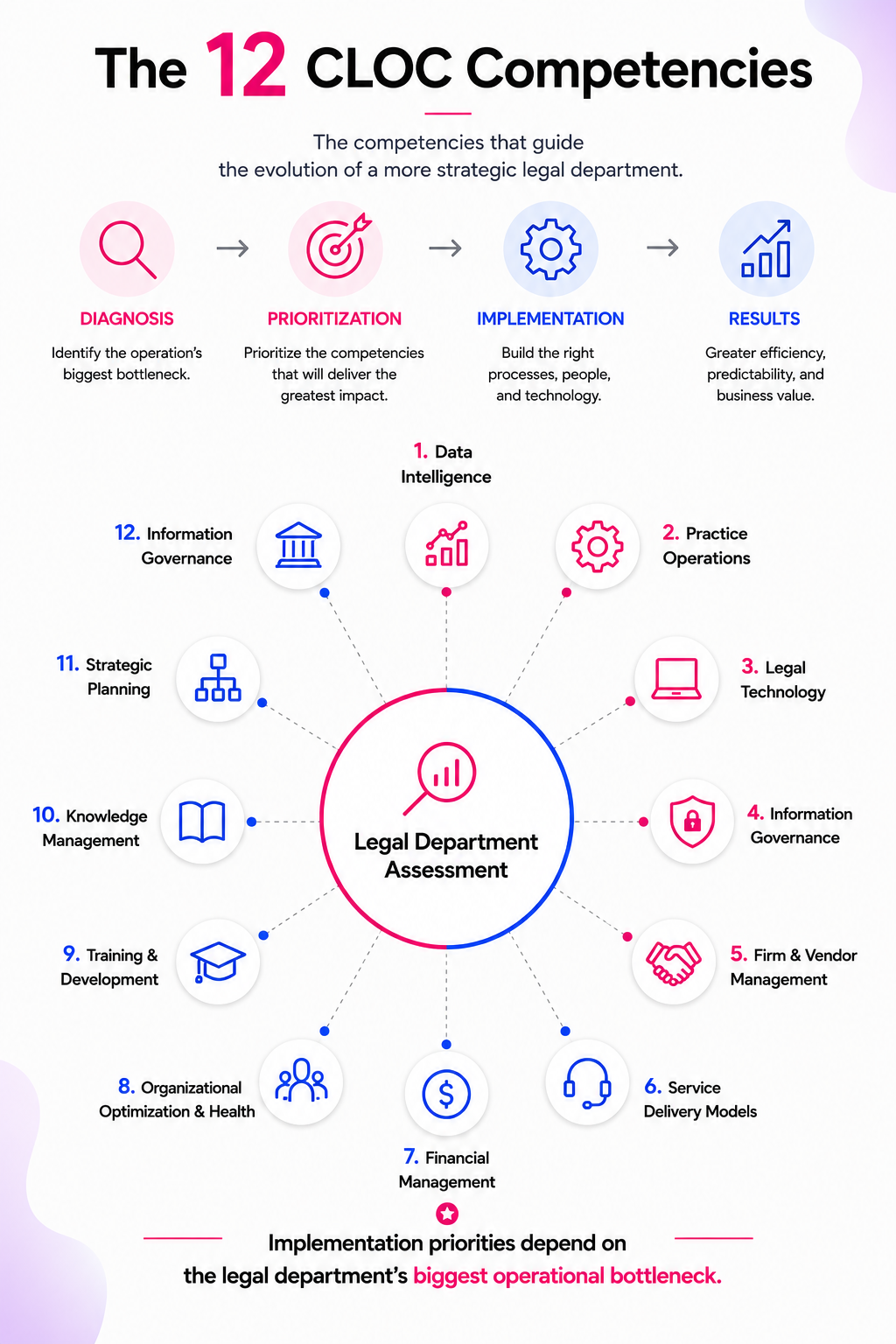
The CLOC model assumes every company has its own needs, which means maturity levels vary by industry and internal structure. Below is the business case behind each of the 12 competencies, framed for the realities of the Brazilian market.
This competency turns raw data and case volume into analytical reports that support decision-making. In Brazil, where legal departments often manage large active caseloads, data intelligence helps identify the main drivers of litigation against the company, map patterns in adverse rulings, and support preventive settlement strategies. For leadership, every percentage point of improvement in the preventive settlement rate, across a caseload of thousands, translates into measurable savings on legal reserves.
Cost control, budget consolidation, and building spend forecasting models fall under Financial Management. Unpredictable spend on contingencies and court deposits tends to create constant friction with finance. Legal Ops brings greater transparency to legal spending and budget management, and more predictability to fund allocation, which makes the annual budget conversation between legal and the CFO far easier.
Firm & Vendor Management covers the technical and commercial relationship with outside firms and legal service providers. The market for outside counsel in Brazil is more fragmented than in the US. That makes it essential to build structured selection criteria and monitor providers against objective performance indicators, making sure the money spent actually reflects the quality of the work delivered.
This area focuses on security, legal compliance, and proper handling of corporate documents throughout their lifecycle. With Brazil's data privacy law (LGPD) in effect, information governance stopped being a best practice and became a regulatory requirement. Gaps here can mean more than a data leak. They can lead to fines from the ANPD (Brazil's data protection authority) and public exposure that lands straight on the board's desk.
The goal here is centralizing and sharing the technical knowledge the legal team has built up over time, reducing the impact of staff turnover. By building a library of standardized templates, best-practice guides, and a record of successful legal strategies, the company cuts down on rework and shortens the ramp-up time for new attorneys joining the team.
This competency focuses on improving internal processes and maintaining a culture that supports people's development. Legal in Brazil still carries a culture of long hours and constant availability, especially in departments with a heavy litigation caseload. Investing here reduces burnout and turnover, both of which are expensive. Recruiting and training a senior attorney takes months, and every departure resets the team's learning curve.
The focus here is managing and coordinating the day-to-day administrative work that keeps the department running. This competency makes sure routine tasks, like opening new case files, tracking court notices, and scheduling hearings, happen without errors or delays, exactly the kind of slip that, in Brazil, can mean a missed procedural deadline and the department being held accountable for it.
Major initiatives, like adapting to new privacy regulations, running M&A due diligence, or responding to new industry rules, require structured management. Legal Ops applies corporate project management methods to track progress at each stage, making sure strategic work gets delivered on time, something that's only grown more important in Brazil given the rising pace of regulatory change, from tax reform to new industry compliance requirements.
This competency evaluates the complexity of incoming work to apply the right delivery model. Based on a strategic look at cost and risk, the team decides what should stay in-house with senior attorneys, what should go to outside partners, and what can be automated end to end.
This competency aligns the legal department's performance goals with the company's broader growth strategy. Structured planning makes sure legal's actions connect directly to the business's commercial expansion and profitability goals set by the board, turning legal into a recurring agenda item in board meetings, not just something that comes up when things go wrong.
Rolling out contract management software (CLM), e-signature platforms, and workflow automation should follow an integrated technology roadmap. In Brazil, this competency carries an extra layer of complexity. Legal departments also need to integrate their own systems with Brazil's Electronic Judicial Process system (PJe) and each court's individual platform, a requirement with no direct equivalent in the US market. Instead of running multiple standalone systems, Legal Ops plans for and ensures these tools integrate with the company's broader ERP.
Keeping the team aligned with a changing market requires ongoing training programs. The goal goes beyond legal knowledge and covers skills in data analysis, finance, and management technology, a real gap in Brazil, since traditional legal education still doesn't cover this kind of content. That often makes internal training the only way to build this skill set within the company.
The complexity and cross-functional nature of these competencies calls for someone dedicated to managing them, someone who isn't splitting focus between legal practice and running the department. That's exactly the kind of demand that created opportunities in the Brazilian market for roles like Legal Ops Analyst, Coordinator, and Manager.
The question of who to hire first depends on the bottleneck diagnosis that shapes how a Legal Ops team gets built. The question facing leadership is different. What matters here is identifying which of the 12 competencies delivers a result concrete enough to support the budget request in the next planning cycle.
The answer depends on which argument lands best with your company's CFO:
If the department keeps facing pushback over spend on contingencies and court deposits, prioritizing Financial Management and Data Intelligence tends to resolve that friction fastest. Together, these two competencies let you bring finance a projected savings on legal reserves, exactly the kind of number that carries a budget conversation.
If the risk keeping the board up at night is regulatory, like privacy law exposure, Information Governance becomes the priority. In that case, the cost of a regulatory fine tends to outweigh the cost of building this function internally, and that comparison is what tips the board's decision.
Companies planning to build a Legal Ops function first need to identify the legal department's biggest operational bottleneck, where the highest volume of rework, risk, or lost time is concentrated. That diagnosis determines where the function should begin, built from day one to solve a real operational problem instead of copying a generic model. Some areas deliver quick wins, like automating repetitive tasks, freeing up team time within the first few months. But the diagnosis also surfaces more specific problems unique to that department, and those deserve priority from the start. That combination, quick wins that build momentum alongside targeted work on the real bottleneck, is what lets the function launch aligned with the actual operation, not a theoretical model.
The twelve CLOC competencies show just how comprehensive this model really is. Data, finance, technology, vendors, knowledge management, people, and projects, every relevant part of a corporate legal department has a defined place within the framework. That's the whole point of the model: giving Legal Ops clear direction on what to watch and prioritize at each stage of the department's maturity.
For corporate legal in Brazil, that translates into a complete roadmap for decision-making, instead of one-off calls about where to invest. This framework acts as a reference guide, showing what the department needs to keep a close eye on and where extra attention pays off in real operational efficiency. Departments that follow this roadmap see concrete results: less time lost on operational tasks, cost predictability in front of the CFO and the board, and a legal function that can back up business decisions with data, not just legal opinions.
The twelve CLOC competencies are the set of areas that make up the maturity model built by the Corporate Legal Operations Consortium (CLOC), used as a reference for assessing how mature a legal department is and prioritizing investment in Legal Operations.
The twelve CLOC competencies organize the field of Legal Operations:
The CLOC model applies to the Brazilian market, but it needs adaptation. Factors like the country's privacy law, high litigation volume, the prevalence of hourly billing among outside counsel, and the need to integrate with Brazil's Electronic Judicial Process system (PJe) change how each competency plays out in practice, even though the twelve-competency structure still holds up as a reference.
The CLOC competency to prioritize first depends on whichever bottleneck is putting the most pressure on the operation. Departments with limited budget predictability tend to prioritize Financial Management and Data Intelligence. Departments with high regulatory exposure, like privacy law risk, prioritize Information Governance. There's no fixed order, the right priority is always whichever one solves the operation's real bottleneck at that moment.
No, implementing the twelve CLOC competencies doesn't need to happen all at once. The most efficient path is diagnosing which bottleneck is putting the most pressure on the legal department and prioritizing the competencies that solve that problem first, moving on to the rest as the function matures.