.png)
The corporate push for efficiency has driven a real shift in how legal departments are managed. Many legal teams have come to realize that meeting corporate expectations while handling growing workloads is no longer sustainable when operations still rely on scattered spreadsheets, email, and other manual processes. That shift is exactly what's fueled the rise of Legal Ops as a career path. Research from FGV Direito SP's Center for Teaching and Research in Innovation (CEPI) shows that most of these functions were created between 2020 and 2024, confirming just how new this specialization still is in the Brazilian market.
Because it's still a relatively young field here, plenty of professionals want a clearer picture of what the role actually involves, and understanding its core pillars is a good starting point for seeing how it's reshaping legal departments across Brazil.
A law degree isn't a requirement for a career in Legal Ops. Because the field focuses on operational efficiency and business management, it's common to see professionals with backgrounds in business administration, finance, engineering, or IT working in this space. In Brazil, training in Legal Ops generally falls into three categories.
These are longer, more in-depth programs, many of them offered online, built for professionals looking for a solid foundation. Looking at current curricula in the Brazilian market, these programs tend to focus on areas like data science and legal analytics, AI governance and technology, legal design and automation, and ethics. That mix of disciplines prepares professionals to build and run a Legal Ops function, translating technical concepts into solutions that improve how legal operations are managed.
These are shorter, more hands-on programs designed to connect directly with the day-to-day demands of the job. Built around active learning and real case studies, they teach the management and technical side of the role in a practical way. Leading programs in Brazil tend to focus on process engineering and contract lifecycle management (CLM), data intelligence and BI dashboards, financial management, and AI applications. This path is especially useful for professionals looking to strengthen specific skills in a shorter timeframe.
Staying active in industry forums and professional networks is key to keeping up with the field. These spaces surface relevant discussions and job opportunities alike. In Brazil, CLOC Brazil is the leading representation of the Legal Ops community, offering guidelines, events, and connections tailored to the local market. Being active in these communities creates real exchange with other professionals and builds practical knowledge grounded in real-world experience across different organizations, while also helping professionals stay current with the challenges Brazilian legal departments are facing.
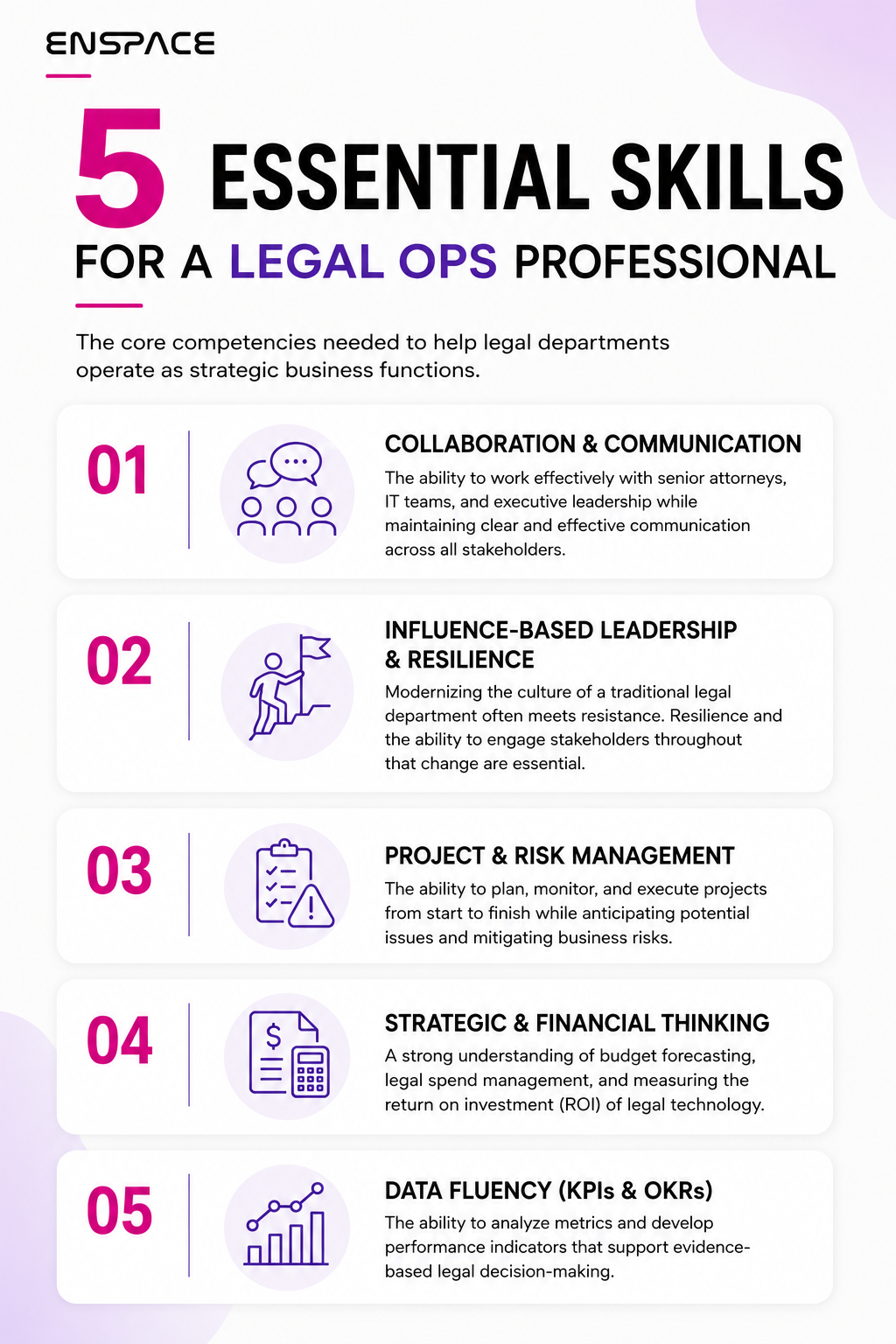
Standing out in this field takes a broader business mindset. The role calls for financial acumen paired with strong soft skills. Among the competencies the market values most:
The ability to work well with senior attorneys, IT teams, and executive leadership alike, keeping communication clear and effective across all of them.
Shifting the culture of a traditional legal department tends to meet resistance. Handling that pushback, and engaging stakeholders along the way, takes real resilience.
Planning, tracking, and executing projects end to end, while spotting failure points early and managing risk to the business.
A solid grip on budget forecasting, legal spend management, and measuring ROI on the tools the department invests in.
Comfort analyzing metrics and building performance indicators that support evidence-based legal decisions.
Developing these skills also opens the door to higher-paying opportunities. In Brazil, market data compiled by Glassdoor shows that compensation varies significantly by seniority and scope. Since career paths in this field are still taking shape, monthly compensation tends to break down roughly as follows (figures in Brazilian reais, BRL):
R$3,500 to R$7,000 - This role sits at the base of the operation, focused on data organization, triaging new legal requests, and maintaining operational workflows.
R$8,000 to R$15,000 - The specialist takes a more analytical role improving and redesigning processes (market average of R$6,900 to R$8,000 base pay), while the coordinator oversees the team's broader project portfolio.
R$20,000 to R$35,000+ - These are senior leadership roles focused on governance and aligning the function with broader business goals. At this level, bonuses and profit-sharing can push total annual compensation past R$370,000.
Location and industry both play a real role in how these numbers shift. Companies in heavily regulated industries or tech tend to offer the most competitive packages.
For professionals looking to stand out in a market still saturated with strictly traditional legal profiles, investing in solid, interdisciplinary Legal Ops training is the safest path forward. Professionals who can demonstrate operational value, financial discipline, and strong process management tend to be the ones who advance more quickly in this career. Helping legal become a more strategic business partner comes down to building influence-based leadership, mastering metrics analysis, and organizing data that's currently scattered across the department.
Once you understand the skills and expectations the market has for this role, the next step is seeing how that knowledge plays out in practice. Knowing exactly what a Legal Ops professional does day to day helps clarify how these different responsibilities come together in a real corporate routine.
No. A law degree isn't required, since the field is focused on efficiency, technology, and business process management. Professionals with backgrounds in business administration, engineering, IT, and corporate finance can build successful careers in this field.
The Analyst works at the operational base, handling request triage, system updates, and repetitive workflows. The Specialist takes on a more senior, strategic role, auditing technology, managing budget forecasting, and designing solutions.
CLOC is the global consortium that sets best practices for legal operations worldwide. Training in this field is largely built around its 12 core competencies, which cover areas like strategic vendor management and data intelligence.
Because a Legal Ops professional needs to help modernize a department's culture and standardize its processes, the role requires the ability to persuade and engage senior attorneys and executives to adopt new technology, even without direct hierarchical authority over them.