There's a quiet disconnect between the legal department and the C-suite at most large companies. Legal leaders tend to equate stacks of reviewed contracts and met deadlines with success. CEOs and CFOs, on the other hand, still see legal as a cost center, a necessary evil. In Brazil, that gap takes on real urgency given one striking number: more than 80 million active court cases currently working their way through the system. The result is technical teams buried in repetitive operational work, while the C-suite pushes for financial predictability and lower spend. That disconnect comes at a real cost. Professionalizing legal management through Legal Ops is quickly becoming the answer to that gap.
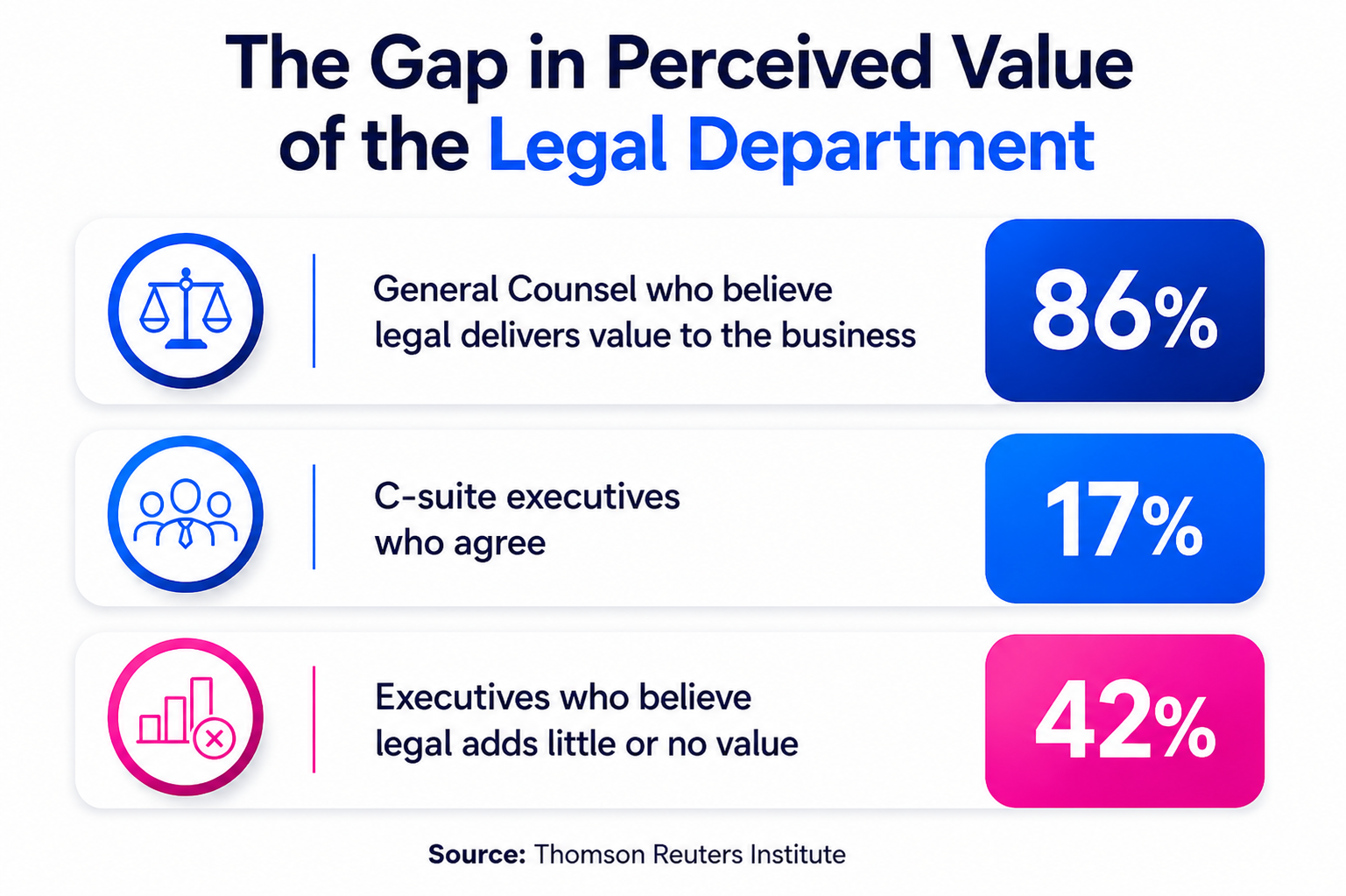
In June 2026, the Thomson Reuters Institute published its global State of the Corporate Legal Department report, and it surfaced a structural, and pretty uncomfortable, disconnect between legal leaders and the executives they report to.
According to the report, 86% of the legal leaders surveyed believed their department made a meaningful contribution to the company's goals. When researchers asked senior executives, CEOs, CFOs, and COOs, the same question, the answer looked completely different. Only 17% of those executives agreed that legal was contributing to the company's objectives.
Another number from the report stands out just as much. 42% of executives said their legal department contributes "little or nothing" to the organization's success.
Legal Operations, or Legal Ops for short, is both a discipline and a dedicated function within legal departments and law firms that applies modern management principles, technology, process engineering, and data analysis to the practice of law. At its core, Legal Ops exists to build the operational infrastructure that lets lawyers focus on strategic legal work, while making sure the department runs as a predictable, responsive business partner with a clear eye on ROI.
The stark perception gap in the Thomson Reuters report exists largely because legal and the C-suite are speaking two different languages. The C-suite runs the business on financial metrics, proactive risk mitigation, time-to-market, and capital efficiency. Traditional in-house legal teams, meanwhile, tend to report on reactive volume metrics: how many cases were filed, how many contracts got reviewed, how many hours went into meetings.
It's not unusual for legal leaders to hand the board a 40-page report full of technical jargon, when what the CFO actually wants to know is how much legal shaved off the cost per signed contract, or how much faster deals are closing.
Telling a CFO the team reviewed 2,000 contracts last month quantifies effort, but it doesn't make the outcome clear. It doesn't answer whether that work moved the needle on cash flow, shortened the sales cycle, or cleared an operational bottleneck. Without the ability to translate legal activity into measurable business value, legal leaders will keep facing a skeptical C-suite, and that perception gap will only widen. Closing it is exactly why Legal Ops exists.
Making that shift work in practice starts with understanding what a Legal Ops professional actually does day to day. That's what turns the strategy into the kind of efficiency metrics the business is asking for.
Legal Ops didn't just show up out of nowhere in Brazil. It's the natural endpoint of how Brazilian in-house legal practice has evolved over time. Research from FGV Direito SP's Center for Teaching and Research in Innovation (CEPI) maps this shift through a few clear stages of maturity, moving from bare-bones administration to predictive business intelligence.
That evolution roughly breaks down into three eras.
Through the early 2000s, running a legal department or law firm in Brazil was a purely administrative, manual, and reactive support function. Paper files, docket books, and deadlines tracked by hand defined this period. Support work was limited to basic tasks like tracking court fee payments, arranging couriers, and filing correspondence. There was no room for process thinking, the goal was simply keeping the paperwork from piling up.
As courts went digital and litigation volume exploded, the old back-office model stopped working. Managing thousands of deadlines by hand was no longer realistic. That's the environment that gave rise to legal controllership.
This was a real management upgrade. It split the strictly legal work, building arguments, running hearings, advisory strategy, from the operational work, docketing, deadline tracking, updating legal software, monitoring SLAs. Legal controllership brought standardization and tight quality control into the department, aimed at making sure no deadline slipped and every system entry could be trusted.
Legal controllership solved the deadline problem, but by the mid-2010s, the business was asking for more. A legal team that didn't miss deadlines wasn't enough anymore, leadership wanted a legal function that cut costs, used technology to streamline workflows, and treated operational data as a strategic asset.
Legal Ops emerged as the natural next step. Where controllership looks backward, focused on making sure the machine runs by the book, Legal Ops looks forward, more like business engineering. It absorbs the control functions of controllership but goes further into data governance, process design, technology architecture, strategic vendor management, and predictive automation.
FGV Direito SP's research found that these functions first gained real traction inside large Brazilian companies starting around 2016. It's only more recently, though, that the field has seen a genuine boom, now reaching law firms just as forcefully as corporate legal departments.
As Professor João José Assumpção Filho points out in an FT Magazine piece on the evolution of Legal Ops in Brazil, the field showed up to fill a long-standing gap left by traditional law schools. Most legal education focuses on litigation, statutory interpretation, and building individual legal arguments, while skipping over the basics of team leadership, project management, corporate budgeting, and technology adoption. Legal Ops brought the professionalism and administrative discipline the field had been missing. As the market grows, finding qualified talent for these roles means understanding exactly which skills separate a strong candidate from the rest. Knowing the typical training path and salary range for the field also matters if you want to attract and keep the best people on your team.
Rolling out Legal Ops in Brazil has become urgent for a reason that's fairly unique to this market: an extraordinarily high litigation volume. The latest report from Brazil's National Council of Justice (CNJ) puts the number of active court cases in the country at 80.6 million.
That volume makes Brazil's court system one of the most overloaded in the world, ruling on roughly four times as many cases as comparable European countries. That kind of caseload hits large corporations hard, chronically overloading their legal departments, especially in high-volume litigation areas like labor, consumer, and tax disputes. In an environment with this much litigation, a boutique, case-by-case approach to legal work just isn't viable. Managing a high-volume active docket takes the precision of an assembly line, since every single case has a direct line to the balance sheet.
The paradox facing legal leaders in 2026 is that Brazil's litigation volume and regulatory complexity keep climbing, while the budget to deal with it isn't growing at anywhere near the same pace. CLOC's 2026 State of the Industry report calls this out directly, describing the emergence of a "structural productivity gap."
Data from that same report makes clear that in-house workloads have grown fastest in high-complexity, high-stakes areas like regulatory compliance and cybersecurity.
With all this pressure, the market reality now boils down to doing more with less. As demand grows in complex practice areas while budget and headcount stay flat, operational efficiency isn't a nice-to-have, it's the only way to keep up. Legal Ops has become the strategic path for legal departments to survive through intentional planning, data intelligence, and disciplined automation.
To see how this pressure actually plays out inside Brazilian companies, FGV's Legal Operations Panorama in Brazil report offers a solid read on the local market. The study, focused entirely on Brazilian businesses, looked at maturity levels and how leading organizations are dividing up operational responsibilities.
Among the Brazilian companies surveyed, 44 organizations already have a formal, active Legal Ops function. An even more telling data point sits in the transition zone: 38 organizations said they haven't formally created a department by that name yet, but already have staff handling Legal Ops-type responsibilities.
Asked what drove their investment in Legal Ops, Brazilian companies pointed to three main pillars.
The biggest bottleneck across the companies surveyed is tool fragmentation. A typical legal department runs one system for litigation, spreadsheets for vendor contracts, email for intake requests from other departments, and separate portals for managing outside counsel. Legal Ops folds all of that into a single, unified platform, breaking down information silos and letting data flow in real time across the department.
The Brazilian market spends heavily on outside legal services, largely because of the country's regulatory complexity. Tracking invoices, enforcing fee schedules, auditing bills, and monitoring outside counsel performance adds up to a massive management burden on its own. Some companies turn to Legal Ops specifically to build strict legal procurement policies and automated financial audit processes.
Mapping a contract's full lifecycle inside a company is one of the most effective ways to cut cost. Companies building out Legal Ops functions in Brazil tend to redesign these processes before automating them, cutting redundant steps and shortening turnaround time (SLA) for the business units they support.
FGV Direito SP's research is clear that there's no single template or formula for building a Legal Ops function in Brazil. Budget, technical scope, headcount, and overall structure all vary based on company size and what the business actually does. Intentional planning and an upfront maturity assessment are non-negotiable if the rollout is going to work.
Building an operation that can hold up under this kind of pressure required the market to settle on a clear methodology. CLOC, the Corporate Legal Operations Consortium and the leading global authority on Legal Ops maturity, developed the CLOC Core 12, a framework built around 12 core competencies that define how mature a legal department's operations really are.
These twelve competencies act as a compass, giving Legal Ops leaders and executives a clear way to spot bottlenecks, decide where to invest, and scale operational efficiency:
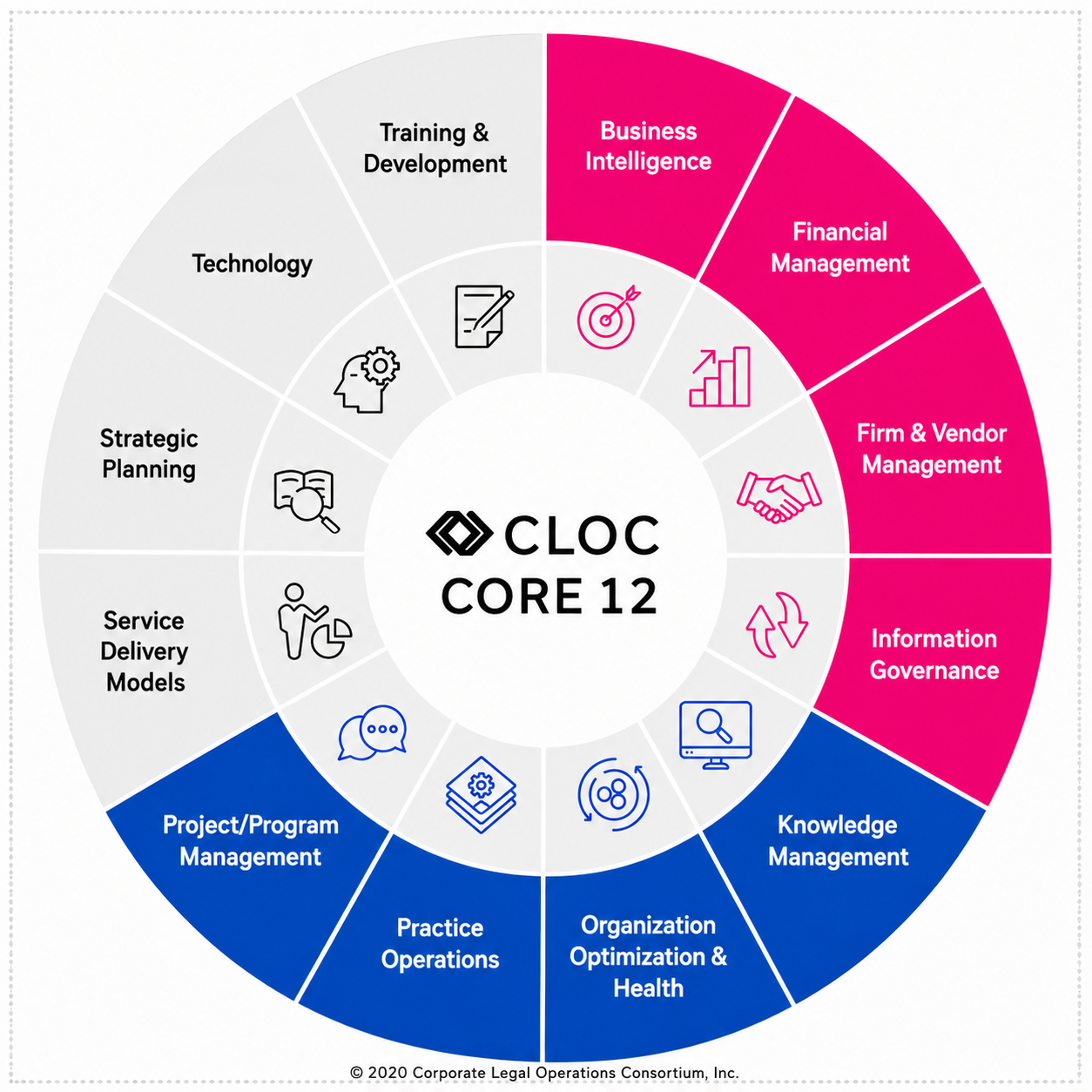
CLOC's 2026 State of the Industry report found that, given the current economic climate, legal leaders are prioritizing three of these competencies above the rest: technology strategy (to automate work), financial and budget management (for internal cost control), and outside counsel and vendor management (to renegotiate contracts and hold vendors accountable for efficiency).
FGV Direito SP's research also found that the defining trait of modern Legal Ops in Brazil is how cross-functional it's become. Legal Ops has opened the door to professionals from outside law entirely, business, economics, engineering, and data science, and they now show up in in-house legal teams in real numbers.
Bringing these disciplines in has changed how in-house legal works. A data engineer can look at a high-volume docket through a purely statistical lens, cross-referencing databases, running legal analytics, and building predictive models. That kind of analysis can point, with real precision, to which court or jurisdiction is statistically more likely to rule against the company on a given legal argument.
A business or finance professional brings tighter cash flow discipline to the department, calculates the exact cost per contract, and tracks outside counsel performance through objective scorecards. With all these disciplines working together, the three pillars of Legal Ops, people, process, and technology, operate in much better balance, and the department avoids paying for expensive systems it doesn't have the processes in place to actually run well.
No conversation about the future of Legal Ops and efficiency in 2026 is complete without talking about AI's impact. Right now, technology is seen as the answer to legal's productivity gap. At the same time, it's exposed some serious governance and management gaps across the legal industry.
A deep-dive published on Thomson Reuters' official blog on how AI is being used inside corporate legal departments surfaced a striking contradiction. 87% of legal professionals believe generative AI will be essential to their daily workflow within the next five years, yet only 40% of organizations are using it in any structured way today.
The same analysis found that most legal departments that have piloted or purchased AI tools simply aren't tracking ROI, or don't know whether they are. They're not measuring business impact, things like reduced fiduciary risk or internal client satisfaction, leadership is mostly looking at surface-level numbers like estimated time saved.
Even as most legal teams are still figuring out basic generative AI use cases, quick legal research, report summarization, first-pass clause review, a far more disruptive and autonomous wave of technology is already here: agentic AI.
Agentic AI systems represent a real leap forward from earlier tools. Traditional models are passive, responding to direct prompts in a chat interface. Agentic AI reasons toward a goal. It's built to act autonomously, running and completing complex business workflows end to end, with minimal human oversight.
In a Legal Ops context, an AI agent does a lot more than summarize a vendor services agreement. It can pull the document in directly from a corporate inbox, check it in full against the company's risk playbook and governance guidelines, flag abusive liability or repricing clauses, draft an adjusted counterproposal, send that response straight to the counterparty, update the contract's status in the CLM system, and, once a supervising attorney signs off, route the document to e-signature.
Agentic AI represents a real opportunity to bring corporate legal costs down to historic lows, freeing teams from repetitive work so they can spend more time on high-impact advisory work.
That said, the market data is clear that successful AI adoption isn't about the tool itself, it's about the management infrastructure built around it. Organizations with a formal, intentional, centralized AI strategy reach a much higher level of maturity, and have a real shot at positive ROI on those initiatives.
Based on where the data points today, building out a legal department isn't optional, it's a matter of staying competitive. Legal controllership, with its split between technical and administrative work, isn't enough anymore. What's needed now is cross-functional sophistication built on process engineering and real governance over the ROI of new technology.
But building a functional operation from scratch, hiring specialized talent, redesigning workflows, and integrating new technology, takes a level of time and financial investment that a lot of departments can't, or won't, commit to.
For companies that want to start building this out right away, without inflating internal headcount, there's an already-established model in the Brazilian market built for exactly this problem: Legal Operations as a Service (LOaaS). In practice, LOaaS tackles the industry's structural bottlenecks through three pillars:
Focus on management, not legal technique: with a cross-functional layer covering administration, process engineering, and analytics, senior attorneys don't have to spend their time on operational work like managing spreadsheets and budgets. They get to focus on the technical work that actually requires their expertise.
Technology access without heavy upfront investment: the as-a-service model gives companies access to advanced, cloud-hosted tech stacks, without the cost and complexity of implementing enterprise systems in-house.
Scalable, elastic capacity: this model also allows operational work to be outsourced with real economies of scale, flexing up strategically whenever seasonal spikes hit.
Adopting this model translates into a real efficiency gain, one where legal starts operating with the speed and predictability that a mature operation requires.
The story of legal management in Brazil, moving from a rudimentary back office to the predictive sophistication of AI, shows just how much the in-house attorney's role has changed. The professionals who stand out today are the ones who understand that legal operations carry real weight on the company's balance sheet.
The perception gap Thomson Reuters uncovered, where only 17% of C-suite executives see real value coming from legal, makes it clear that plenty of departments still haven't managed to prove their worth. Legal Ops has increasingly become the path to closing that gap. In Brazil specifically, it's also the path to managing an exceptionally high litigation volume.
Departments looking to make that shift in governance can turn to ENSPACE, the platform that brings litigation, contracts, advisory work, and the full legal operation into one place, cutting out manual rework and fragmented systems, with the real-time traceability and visibility that both legal and the CFO need to protect the business.
Success in legal, in 2026, comes down to how clearly a department can show its results. Legal Ops delivers the operational intelligence, predictability, and administrative rigor it takes to shift an operation's maturity level and hit the efficiency bar the market has always expected.
A Legal Ops professional runs the business and administrative side of the legal department. That includes annual budgeting, designing and optimizing workflows, selecting and rolling out technology, analyzing operational data (KPIs), and managing outside vendor performance, all so the legal team can stay focused on strategic legal work.
Legal controllership is mostly backward-looking and internally focused, built around operational security, meeting court deadlines, filing on time, and standardizing how data gets entered into systems. Legal Operations includes that same security layer but adds a forward-looking, business-driven view, built on data-driven, ROI-focused intelligence, technology governance, cross-departmental process architecture, and aligning legal with the C-suite's financial goals.
Because CEOs and CFOs run the business on financial efficiency and proactive risk management. Legal Ops acts as the translator, turning legal's operational effort into business metrics leadership can actually use, showing reduced fixed costs, tighter control over cost per signed contract, and fewer bureaucratic bottlenecks slowing down revenue.
Legal departments that run their operation on ENSPACE report a 40% increase in operational efficiency and approvals that move 3x faster. Beyond speed, centralizing data gives senior leadership full visibility into reporting and drives a sharp reduction in fiduciary and operational risk.