If you tracked your team with a stopwatch for a week, you'd discover that half the day disappears into holes that nobody has mapped. The good news is that those holes aren't random — they have patterns. And patterns can be addressed.
In the three previous editions, we named the problem (invisible time), showed why measuring wrong is part of the cause, and established why vertical legal software won't solve it. Now we begin the surgical part: locating exactly where time escapes.
The list below isn't exhaustive. It's a taxonomy of the seven most common leaks in corporate legal departments — observed in teams of five and teams of fifty. Each has its own mechanics, estimated cost, and — crucially — the possibility of being addressed once identified.
Invisible time isn't random. It repeats. And what repeats can be named, measured, and undone.
It's the most documented and the most underestimated. Research from the University of California, Irvine, conducted by Professor Gloria Mark over two decades, established a benchmark number: it takes an average of 23 minutes and 15 seconds to fully recover focus after a significant interruption. Analysis from Harvard Business Review estimated that knowledge workers toggle between applications and websites more than 1,200 times per day, spending approximately four hours per week simply reorienting.
In legal, this leak is especially expensive because the work demands depth. Analyzing a complex clause, drafting a memorandum, comparing precedents — all of it depends on maintaining an active mental model. When a Slack message breaks that model, it's not just the minute of the reply that's lost. It's the minutes of cognitive reconstruction. In a day with six meaningful interruptions, that's nearly two hours lost just in mental transition — not in the work itself.
Research by APQC with 982 knowledge workers found that each worker spends an average of 2.8 hours per week just looking for or requesting information they need to do their job. In legal departments, this number tends to be higher, because legal work depends intensively on precedents, prior versions, past contracts, and the historical context of decisions.
The familiar question — where's that vendor agreement we approved with Company X in 2022? — is the symptom. The answer involves opening three systems, searching old emails, asking a colleague, waiting for a reply, and sometimes giving up and starting from scratch.
Every time a request passes from one person to another — from the associate to the senior counsel, from legal to finance, from outside counsel to in-house — there's a transfer cost. Context needs to be re-explained. Previous decisions need to be re-justified. Documents need to be re-presented.
In corporate legal departments, many requests pass through three to five handoffs before completion. And at each handoff, 10% to 30% of the original context is lost. The result is that final decisions are frequently made with incomplete information — and the team spends time afterward correcting what was decided without context.
Bloomberg Law's survey found that tracking tasks and deadlines was the most common collaboration challenge (41% of respondents), followed by getting a clear picture of project status (39%). In a department with twenty active matters, this means the legal operations manager answers, on average, twenty times per week the same question, slightly reformulated: what's happening with matter X? Any update on matter Y?
The central issue is structural: business stakeholders ask for status because they don't have visibility. They don't have visibility because the information lives in systems they don't access. And the way most legal departments solve this is the worst possible way: responding individually, repeatedly, manually.
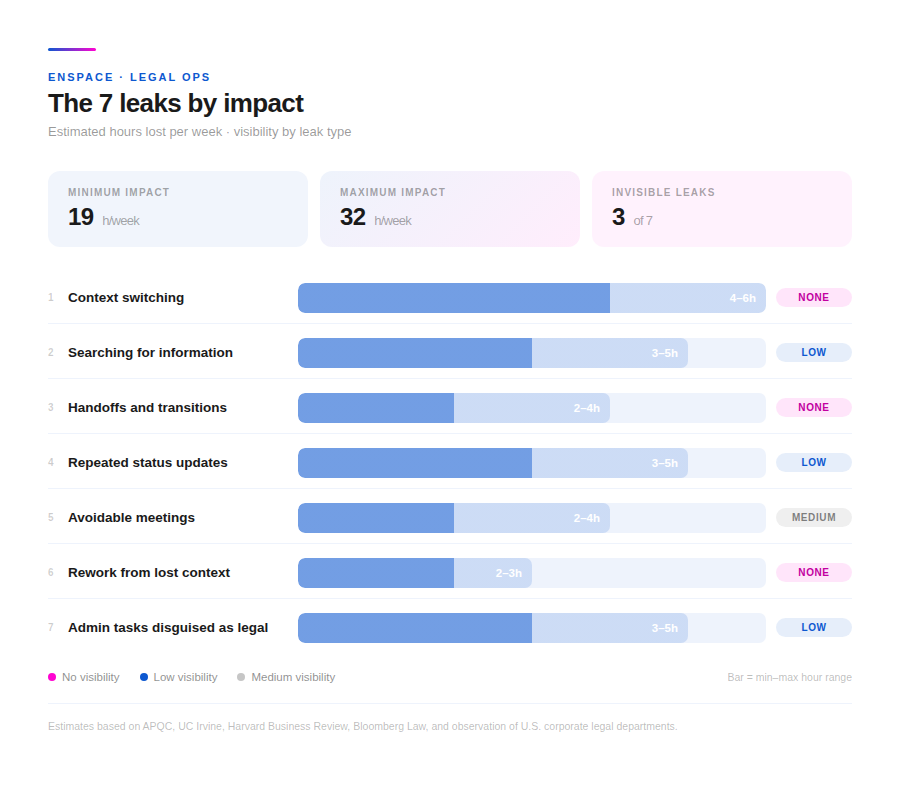
Global research on meeting time brings numbers that provoke: only 11% of meetings are considered productive by the participants themselves. 77% of professionals report attending meetings whose only outcome was scheduling another meeting. Managers attend an average of 12 meetings per week; directors and VPs reach 17.
In legal, a specific cultural habit amplifies this leak: the belief that sensitive matters should be handled live, in a meeting, with all parties present. The intention is good. The practical effect is that many decisions that could fit in a structured async message become 30-minute meetings with five people. The next edition is dedicated entirely to this leak.
This is the most frustrating leak of all, because it involves redoing work that was already done. It happens in three common forms: re-analyzing an issue because the person who requested it forgot the context and came back asking something already answered months ago; re-reviewing a contract because the original version wasn't accessible and it was faster to start over; re-writing a communication because the first version was misunderstood. The next edition after meetings will be dedicated to this leak.
There's a category of work that lives in legal not because it requires a law degree, but because no one else will do it. Internal system data entry. Spreadsheet filling for other departments. Collecting signatures in manual workflows. Vendor onboarding paperwork. These tasks are executed by professionals with training and hourly costs far higher than necessary.
Bloomberg Law's survey found that attorneys spent two out of every eight working hours on administrative duties. The InView 2024 report estimated that in-house teams waste up to three hours per day on manual administrative tasks. In smaller teams, this percentage can reach 40%.
Identifying the seven leaks in your department doesn't require consulting, software, or budget. It requires five days of structured observation.
The result is an initial diagnosis — imperfect but honest. And it provides the basis for the conversation that needs to follow: what to do about it.
Meetings. The category of work that consumes more calendar space than any other in modern legal departments. We'll look seriously at when meetings make sense, when they destroy productivity, and why legal still hasn't learned the structured async communication that other functions mastered long ago. Includes a practical playbook for canceling 30% of your team's meetings this week — without losing coordination quality.
Brazil
Rua Luiz Seráphico Junior, 511,
2nd Floor, São Paulo/SP
Telephone: +55 11 3294-0935
United States
4700 Millenia Boulevard, 500,
Office 5124, Orlando, FL - 32839
Phone: +1 718 419-3414
Safety and Quality Certifications

Deployment guaranteed by
Associations and Partnerships

Recognized by