Ask a legal operations manager how the team is doing.
The answer almost always comes in the same form: swamped. Buried. Backlogged. No bandwidth. Calendar packed through end of month.
Now ask what the most meaningful outcome was last month. What improved. What moved forward. The silence is usually eloquent.
That silence isn't a lack of merit. It's a lack of measurement. There's a quiet confusion that costs nearly every modern legal department dearly: the confusion between being busy and being productive. They are different things. Frequently, they are opposite things. And most legal tools, processes, and cultures reinforce the former at the expense of the latter.
There's a seventeenth-century English word for this: spuddle. It means to be extremely busy while accomplishing absolutely nothing. It was coined four hundred years ago and perfectly describes Wednesday morning in most legal departments.
A packed calendar is the most seductive metric there is. It's visible. It's measurable. It's easily communicated to the C-suite. And it's almost always a trap.
A packed calendar measures occupied capacity, not delivered value. It measures demand received, not problems solved. It measures effort invested, not results obtained. And worst of all: it creates a perverse incentive, because a team that reduces its workload — even by eliminating unnecessary work — appears to have become less important.
This is the paradox of the busy legal department. The busier a department appears, the greater the justification for its existence, the more budget it defends, the more respect it projects. But high occupancy is also the most common symptom of broken process. Departments with well-designed workflows aren't busy all the time — they're delivering all the time, which is a different thing.
The difference between busyness and delivery becomes clear in a simple thought experiment. Imagine two legal teams identical in size, seniority, and budget.
Team A is always slammed: packed calendars, everyone rushing, messages pouring in all day.
Team B seems calm: calendars with whitespace, people with time to think, predictable cadence.
Which one delivers more value to the business? Intuition says A. The evidence, in nearly every study of knowledge work productivity, points to B.
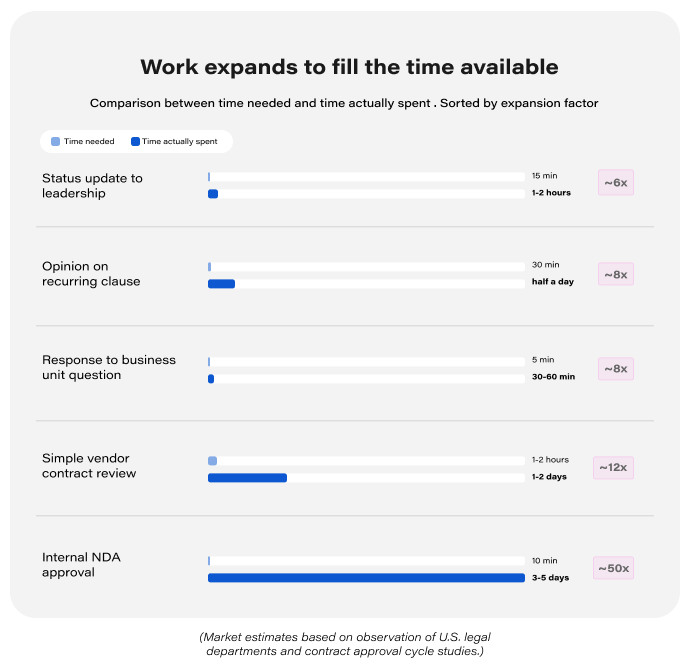
In 1955, British historian Cyril Parkinson made an observation that would become famous: work expands to fill the time available for its completion. The statement seems simple. The consequences are profound — especially in legal environments.
Parkinson illustrated the principle with the story of an elderly woman whose only task for the day was to mail a postcard. She spends an hour finding the card, half an hour looking for her glasses, ninety minutes writing, and ends the day exhausted — having delivered one postcard. Without time pressure, any task expands to consume the entire day.
In legal departments, this law operates with amplified force. There are three reasons.
The first is that legal work rarely has a clear endpoint: there's always another clause to review, an alternative theory to consider, one more precedent to check.
The second is the culture of rigor: better to deliver late and thorough than early and incomplete.
The third is the absence of immediate external pressure: unlike sales (which has monthly quotas) or operations (which has client-facing SLAs), legal rarely has someone pushing for speed — only for quality.
The result is predictable. Tasks that could take two hours take a day. Tasks that could take a day take a week. And the extra time doesn't go to more quality — it goes to more revision, more double-checking, more alignment meetings, more waiting for approval. The marginal quality gain is tiny. The productivity loss is enormous.
Research in knowledge work productivity has shown that when deadlines are cut in half, the quality of output doesn't drop by half — it frequently stays the same or even improves, because the team is forced to focus on what matters. What drops is the time spent on refinements that no one notices.
In software engineering, there's an important distinction that legal hasn't yet imported: the difference between throughput (volume of tasks processed) and outcome (value generated for the business).
Throughput is easy to measure. How many contracts did the team process this month? How many opinions were issued? How many matters were moved forward? These are nice numbers for a committee presentation. They justify headcount. They grow year over year if the company grows.
Outcome is hard to measure. Did the contract the legal team reviewed prevent a future problem? Did the opinion change a business decision? Was the matter movement the right one? These numbers require reflection, context, and often retrospection. They rarely fit in a monthly report.
The problem isn't that throughput is useless. It's that it's insufficient. A legal department can increase throughput by 30% without the company noticing any improvement — because the extra work processed may have been unnecessary work, rework, or low-impact tasks. More output doesn't mean more value.
Worse: focusing on throughput creates incentives to avoid complex work. Simple, repetitive, serially processable tasks inflate the number. Deep, strategic, time-consuming tasks lower it. Which will the team prioritize when the metric is volume processed?
If there's one metric that needs to be retired from legal departments, it's hours worked. Not because it's dishonest — everyone does work the hours they report. But because it measures the wrong thing with impressive precision.
Hours worked measures input, not output. It measures time invested, not value generated. It measures presence, not impact. In legal teams, it creates three specific distortions:
If what's measured is time spent, spending too much time becomes a virtue. The attorney who resolves a case in three hours looks less dedicated than the one who spends two days on the same problem. Productivity becomes the enemy of reputation.
Tasks that take many hours seem more relevant than tasks that take few. But relevance is defined by business impact, not duration. A five-minute decision can be far more important than a forty-page memorandum.
If the team adopts a tool that reduces a two-hour task to twenty minutes, hours worked go down. In an hours-measuring culture, this looks like declining performance. In an outcome-measuring culture, it's the opposite: it's exactly what you want.
There's a blunt observation from Jason Fried, founder of Basecamp, about modern knowledge work: very few people actually work eight hours a day. You're lucky if you get a few good hours in between all the meetings, interruptions, web browsing, office politics, and personal business that permeate the typical workday. The statement is harsh, but it captures something important: measuring presence in hours is measuring a fiction. What matters is what fits inside the hours, not the hours themselves.
If hours and throughput don't work, what does? There are four indicators that modern legal departments use — and that change the game when applied seriously.
How long between a request arriving at legal and leaving resolved? This indicator measures flow, not effort. An efficient department reduces cycle time without increasing headcount. An inefficient one compensates for high cycle time by hiring more people.
What percentage of requests come back to legal after being theoretically resolved? They come back because the business unit didn't understand. They come back because context was missing. They come back because a decision was made with incomplete information. Every return is doubled time, and rework rate is the most honest thermometer of actual process quality.
Would the business units that depend on legal recommend the department? This metric captures something no other captures: perceived usefulness. A technically impeccable legal department that is inaccessible, slow, or unclear scores low. An agile and clear one scores high. And high NPS correlates strongly with real value generation.
This is the most underused and most powerful metric. How many requests did legal manage to prevent before they became requests? Training the sales team on critical clauses, FAQ that answers recurring questions, self-service templates that eliminate the need for legal review on simple cases. Each deflected demand is a double win: time saved and process matured.
A legal department at a mid-size U.S. company — specifics withheld for confidentiality — started a simple exercise in January: for every incoming request, record who asked, which department, and what type. That's it. No process change, no new tool, no training.
Within three months, patterns emerged. Five questions accounted for 40% of all requests. Three departments accounted for 70% of volume. A single question about a specific vendor indemnification clause appeared, on average, eight times per week — always from the same sales team.
The team then took three actions: created a one-page document explaining the clause in plain business language, trained the specific sales team in a one-hour session, and set up a self-service channel for frequently asked questions.
Within six months, total request volume dropped 30%. Not because the work decreased — because the unnecessary work decreased. The remaining requests were, on average, more complex and more relevant. The team, with the same headcount, finally had bandwidth for strategic projects. And internal NPS went up, paradoxically, with legal doing less.
The lesson isn't about the result itself. It's about the starting point: measurement. Before the exercise, nobody knew there was a single question appearing eight times a week. The invisible time of that repetition had existed for years, cost real money, and was literally invisible.
The first edition named invisible time. This second one showed why measuring wrong is part of the problem. The next — the last of the Diagnosis phase — touches something uncomfortable: why the legal software your department loves was not built to solve your biggest problem, and why adopting more vertical tools frequently makes things worse.
It's not a criticism of legal tech. It's an observation about scope. And it explains why so many legal departments invest heavily in technology and still feel like they're drowning.


Brazil
Rua Luiz Seráphico Junior, 511,
2nd Floor, São Paulo/SP
Telephone: +55 11 3294-0935
United States
4700 Millenia Boulevard, 500,
Office 5124, Orlando, FL - 32839
Phone: +1 718 419-3414
Safety and Quality Certifications

Deployment guaranteed by

Associations and Partnerships

Recognized by